












Knees Weak, Mom’s Spaghetti? Try These 6 Trampoline Exercises for Kids to Improve Their Joint Mobility & Stability
Can you resist bouncing on a trampoline when given the chance?
If even adults can’t withstand the temptation, then kids will definitely pounce on it without a second thought.
But what if your child tells you that their knees hurt after just a few jumps?
This is a cause for concern and can quickly trigger anxiety if you're an unprepared parent.
After all, you want your little ones to stay active and build the coordination needed for all kinds of sports, but never at the expense of their safety and well-being.
The good news is that weak knees don’t mean no more jumping.
With the right approach, you can turn your outdoor play equipment into a specialised tool that builds your child's physical resilience.
Is Trampoline Good for Weak Knees?
Yes, but only if you prioritise stability over height.
A 2026 study published in the Journal of Human Sport and Exercise found that regular trampoline training significantly improves both knee muscle strength and dynamic balance.
For kids with wobbly knees, the goal isn't to see how high they can fly.
It’s to use the trampoline’s surface to engage the muscles that protect the joint.
A high-quality mat can absorb much of the impact that concrete or hardwood would send straight to a child's growth plates.
Growth plates are the soft, developing areas of cartilage near the ends of kids' bones that allow them to grow. Since they haven't hardened into solid bone yet, they're more sensitive to high-impact stress.
Try guiding your kids to perform these 6 joint-friendly trampoline exercises:
-
Stabilising March
- March in place in the centre of the mat.
- Keep the standing leg slightly bent while lifting the other knee.
- This teaches the knee to stay stable under a shifting load.
-
Seedling Bounce
- Keep toes and balls of the feet in constant contact with the mat.
- Use only the ankles and heels to create tiny, controlled pulses.
- This strengthens the lower leg without the jarring impact of a full landing.
-
Statue Balance
- Try to stand on one leg for 10 seconds while the mat is still vibrating.
- This works the stabiliser muscles around the kneecap to maintain balance.
-
Soft-Landing Squat
- Perform slow, shallow squats on the mat.
- The slight give of the trampoline surface forces the glutes and quads to work harder to keep the knees from collapsing inward.
-
Lateral Glide
- Slowly shift the weight from one leg to the other in a side-to-side motion without lifting the feet.
- This strengthens the lateral ligaments (MCL/LCL) that stabilise the inner and outer knees.
-
Tandem Walk
- Try to walk in a straight line, heel-to-toe.
- Doing this on a moving surface is an elite-level stability drill for young gymnasts and soccer players.
These controlled movements are rooted in Proprioceptive Neuromuscular Facilitation (PNF), a science-based physical therapy method used to help the brain and muscles communicate more effectively.
They build the quadriceps and calf strength needed to keep the knees aligned and supported, and prevent injury during sudden stops and pivots.
Watch your child master these trampoline exercises and feel more confident playing at home and participating in their favourite sports.
Why Your Choice of Outdoor Play Equipment Matters for Joint Safety
These trampoline exercises for kids effectively strengthen their joints.
The surface beneath your child’s feet is just as important to their progress.
For a child with low knee mobility, a predictable and consistent bounce on a trampoline is a non-negotiable safety requirement.
This is where the engineering of the trampoline itself acts as a safety guardrail.
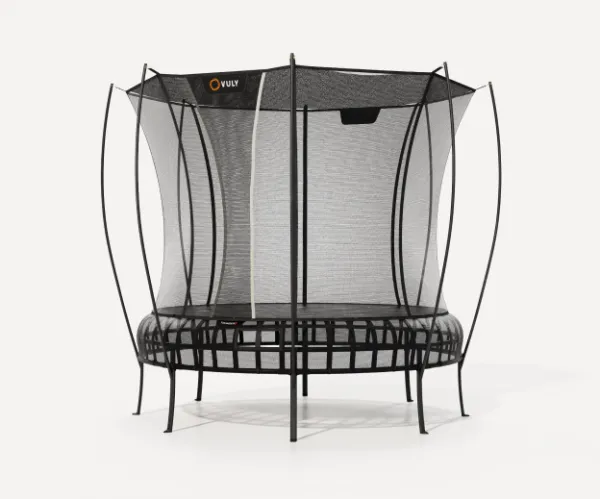
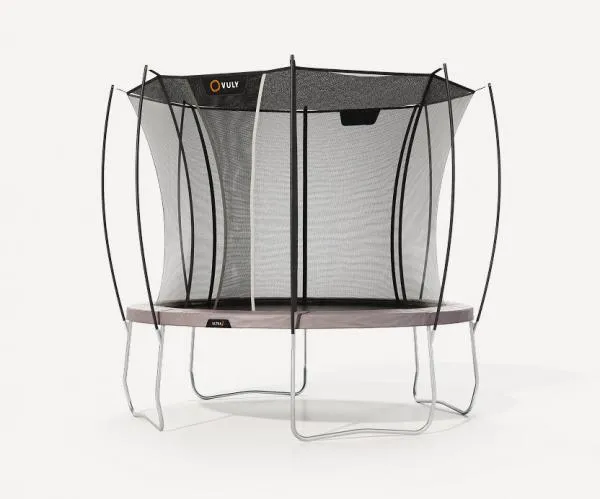
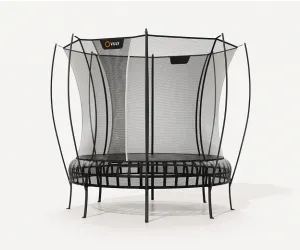
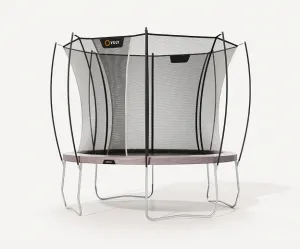
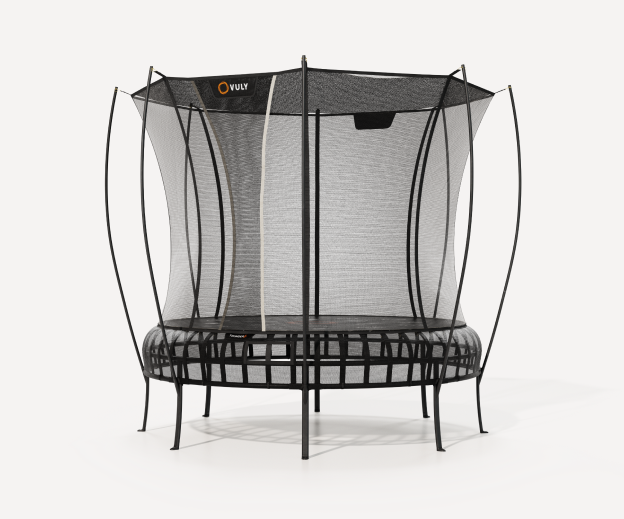
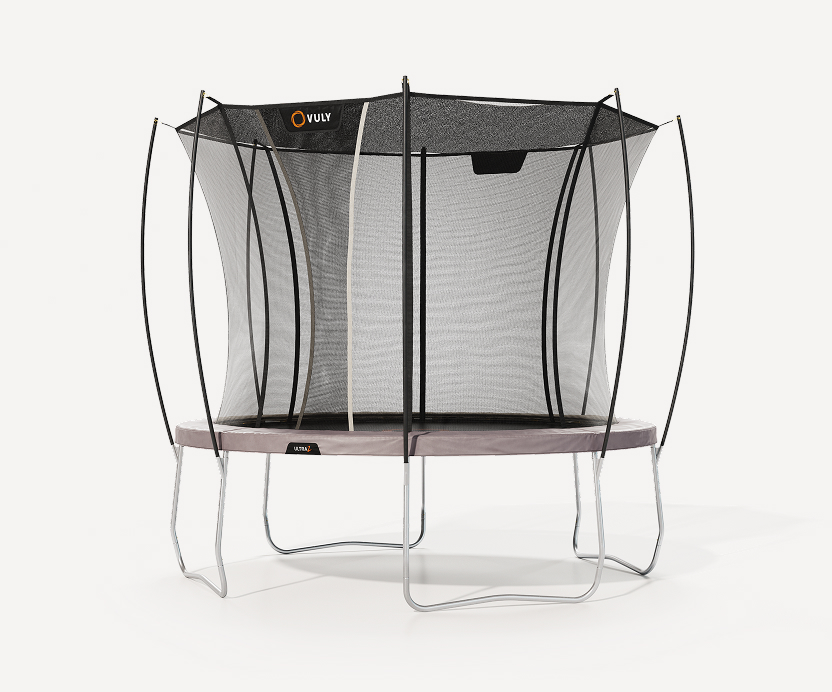
For example, a leafspring trampoline that does not use conventional coil springs employs a 360-degree approach to backyard safety:
-
Patented Full Leaf Spring Technology
- Unlike traditional coils that can create dead spots or uneven tension, these vertically oriented springs absorb energy evenly across the mat.
- This reduces undue stress that can cause a child’s knee to buckle or twist.
-
Integrated Safety Netting & Flexible Net Poles
- This system creates a secure, gap-free enclosure with poles that curve away from the jumper.
- If a child loses their balance while bouncing, the netting gently directs them back to the centre without hitting a rigid frame.
-
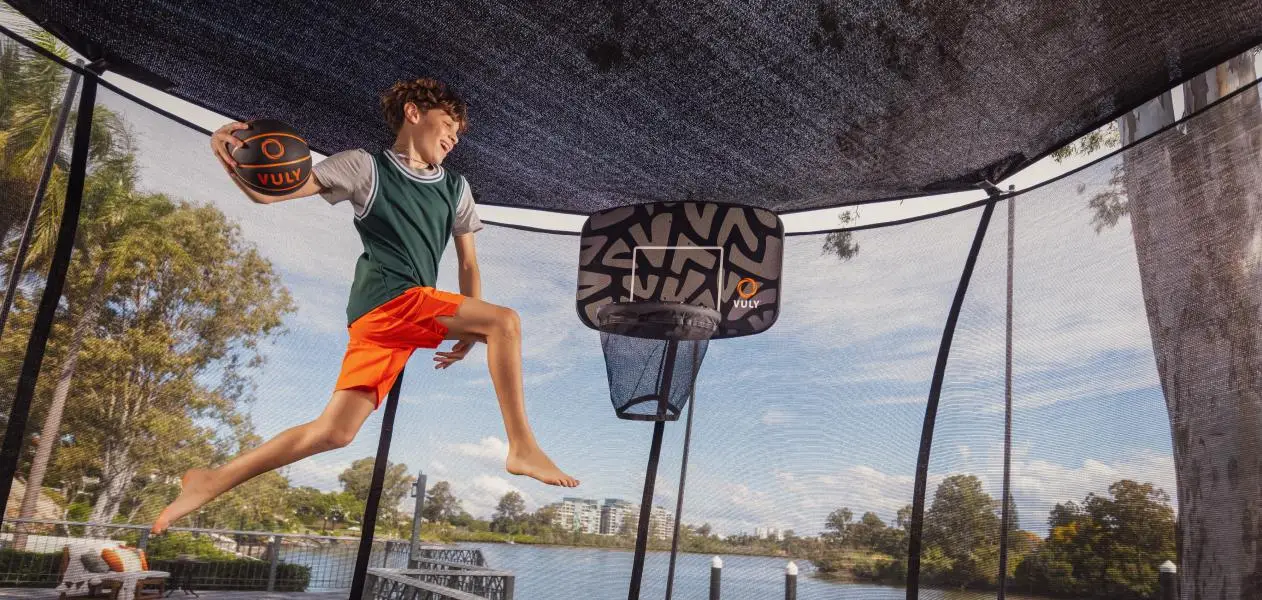
Custom-Fit Shade Cover
- The sunroof doubles as an overhead barrier that helps limit bounce height while providing shade.
- Helps kids stay safely within the enclosure, preventing them from bouncing too high or flying off the trampoline.
When the mat is predictable and the play area is protected, your child can focus entirely on their stability drills without worrying about awkward landings.
Find the right trampoline to help your child play and grow without the ouch.
Get More Stability Tips & Play Ideas
Follow Vuly Play on Facebook, Instagram, and TikTok for more expert tips on pediatric-friendly exercises and engineering updates so your kids can stay safe, active, and injury-free.
References
Hindle, K., Whitcomb, T., Briggs, W., & Hong, J. (2012). Proprioceptive Neuromuscular Facilitation (PNF): Its mechanisms and effects on range of motion and muscular function. Journal of Human Kinetics, 31(2012), 105–113. https://doi.org/10.2478/v10078-012-0011-y
Xie, Y., Eungpinichpong, W., & Panyaek, N. (2026). Effects of mini-trampoline exercise on neck and knee muscle strength, range of motion, and health-related fitness in sedentary adults. Journal of Human Sport and Exercise, 21(2), 733–745. https://doi.org/10.55860/6k972x29